
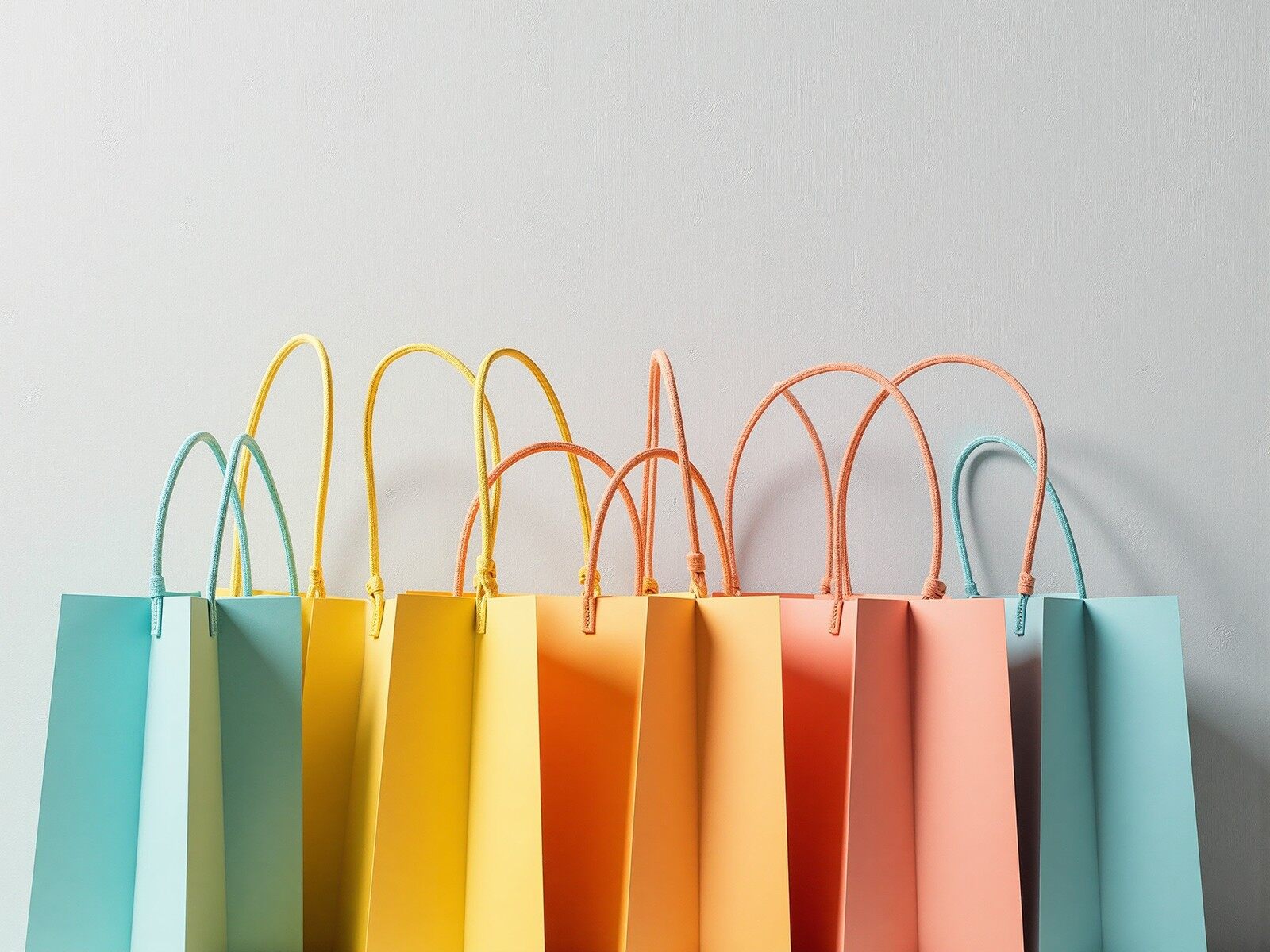
Designing paper bags and tote bags for trade shows requires balancing bold branding with practical durability. Here is exactly how to get it right in 2026.
Last month, a marketing director came to us in a total panic. Their trade show bags from a previous supplier were flimsy, the logo was barely legible from a distance, and the twisted paper handles were tearing off after carrying just two brochures. Sound familiar?
Designing paper bags and tote bags for exhibitions isn't just about slapping a logo on a blank canvas. It’s about creating a walking billboard that actually survives a three-day convention. Here is exactly how to design paper bags and tote bags that work as hard as your sales team.
Get the Dimensions and Material Right First
Look, you can have the most stunning typography in the world, but if the bag rips when someone picks it up, your brand looks cheap.
For trade shows, we generally recommend a weight between 150 GSM and 250 GSM for custom paper bags. Why? Because attendees will stuff them with heavy catalogs, water bottles, and swag. Going below 150 GSM is a gamble. Going above 250 GSM? You're just paying for extra freight costs, honestly.
If you're leaning towards reusable options, our canvas tote bags or thick cotton blends are the way to go. They cost roughly $1.50 to $3.50 per unit depending on the print complexity, but they stick around long after the event ends. For a more eco-friendly, budget-conscious vibe, uncoated kraft paper bags in 120-150 GSM hit the sweet spot around $0.50 to $0.90 each.
The Step-by-Step Design Process
Let's break down how we actually build these at our facility. It’s not magic, just a systematic approach.
1. Define the primary job
Is this bag meant to hold a single lightweight flyer, or a 5-pound product sample? This dictates everything from the gusset width to the handle type. Flat paper handles are fine for light loads, but if you're expecting heavy items, go for twisted paper or even cotton rope handles.
2. Design for the 10-Foot Rule
Here's the thing: trade show floors are chaotic. Your logo and key message need to be readable from 10 feet away. Keep the design clean. Use high-contrast colors. Don't cram your entire company history onto the bag.
3. Choose the right print technique
For simple logos and solid colors, flexography is cost-effective. But if you have full-color photography or complex gradients, offset printing is your best bet. We usually recommend offset for orders over 1,000 pieces because the per-unit cost drops significantly, usually landing around $0.80 to $1.50 per bag.
4. Don't forget the gussets and base
People forget that the bottom and sides of the bag are prime real estate. A subtle pattern or a secondary brand element on the gussets can make the bag look premium without cluttering the main panel. And a bag without a reinforced bottom is just a paper envelope waiting to fail. We use a 2mm to 3mm thick cardboard base for anything over 150 GSM.
Designing for Specific Trade Show Niches
There's no one-size-fits-all approach. What works for a tech expo will look completely out of place at a beauty convention.
Tech & Electronics: Needs to look sleek and modern. Matte black or dark navy with spot UV on the logo works wonders. Just make sure the interior is reinforced, as tech swag tends to have sharp corners.
Beauty & Cosmetics: Needs to feel premium. Soft-touch coating and gold foil stamping are standard here. But watch out for scuffing. A matte lamination is mandatory, even if it adds about 10-15% to your overall cost.
Food & Beverage: If you're handing out samples, grease resistance might be necessary. But mostly, you just need sturdy. Kraft paper with simple 1-color flexo print works best here, keeping costs low while maintaining an organic feel.
Common Mistakes That Ruin Good Designs
We’ve seen a lot of files come through our pre-press department. Here are the ones that make us cringe:
Ignoring the bleed: If your background color doesn't extend at least 3mm past the cut line, you'll end up with ugly white borders.
Using RGB instead of CMYK: Your vibrant neon green on screen will look like muddy olive green in print. Always convert to CMYK. Better yet, use Pantone spot colors if you need exact brand matching.
Overloading with text: A trade show bag is a billboard, not a brochure. Keep text under 20 words.
Choosing the wrong finish: Uncoated matte looks elegant but can scuff easily on the trade show floor. A matte lamination or a soft-touch coating fixes this.
File Prep & Specs (The Boring but Crucial Stuff)
Before you hit send on your files, make sure they meet these specs:
Format: AI, EPS, or PDF. No JPEGs or PNGs for the final print file.
Resolution: 300 DPI minimum for any raster images.
Fonts: Outline all your text. If you don't, our RIP software might substitute a font, and suddenly your sleek sans-serif becomes a blocky Times New Roman.
Lead times: Once the design is approved, typical production takes 7-15 days. But don't wait until the last minute. Rush fees are real, and they usually add 20-30% to your total bill.
Why Factory Experience Matters
You might be wondering if it matters where you print these. Frankly, it does. When you work with an ISO 9001 and FSC certified facility like ours, you're not just getting a vendor. You're getting a partner who understands that a 500-piece MOQ needs to look just as good as a 50,000-piece run. We've spent 37 years perfecting the ink-to-paper ratio, ensuring your brand colors pop exactly as intended.
Designing for trade shows is a balancing act between aesthetics and brutal reality. Start with the end-user in mind. What will they be carrying? How far away will they be viewed? Get those fundamentals right, and the rest of the design will naturally fall into place.